Biorbyt: Discover how lipid nanoparticles revolutionize drug delivery with components like cholesterol, phospholipids, and ionizable lipids, enhancing stability, efficiency, and biocompatibility in medical applications.
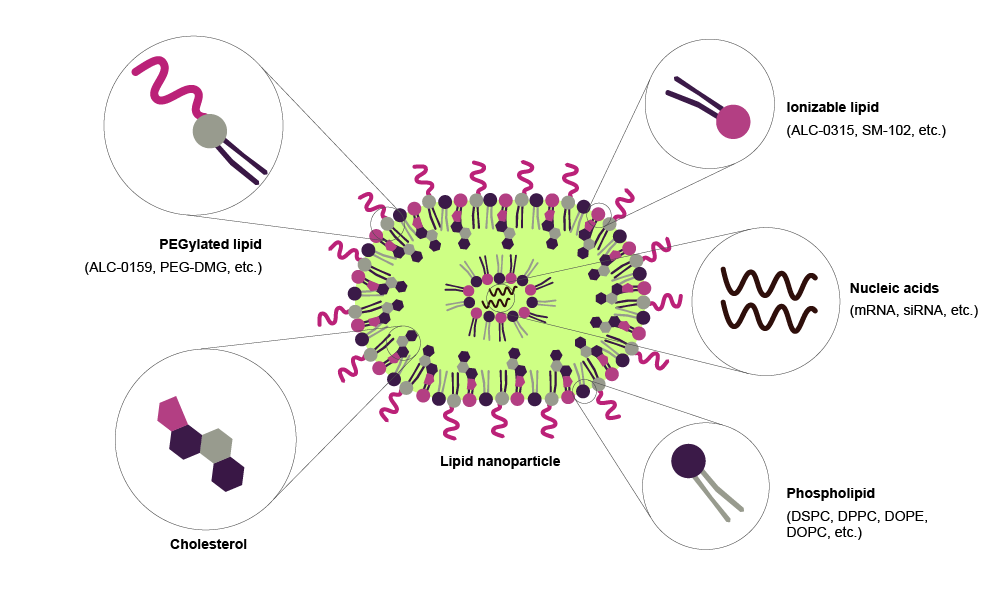
Lipid nanoparticles represent a revolutionary class of drug delivery systems, designed to transport therapeutic payloads with precision and efficiency. At the core of these nanoparticles lies a carefully selected ensemble of lipids. Lipids are amphiphilic molecules that contain three domains: a polar head group, a hydrophobic tail region and a linker between the two domains.
Components of Lipid Nanoparticles
Cholesterol
Cholesterol ensures membrane stability and fluidity. Its inclusion is ideal for applications requiring extended circulation time and enhanced structural integrity. The molecular geometry of cholesterol derivatives can further affect delivery efficacy and biodistribution of lipid nanoparticles.
Phospholipids
Phosphatidylcholine provides the amphiphilic nature necessary for the formation of lipid bilayers in nanoparticles. These lipids contribute to the stability and biocompatibility of the formulation.
DOPE is a phospholipid emulsifier used to facilitate DNA-liposome complex transport across membranes. It is used in combination with cationic phospholipids to increase efficiency during DNA transfection studies as a non-viral method of gene delivery.
1,2-DSPC is used to synthesize liposomes, and is the lipid component in the lipid nanoparticle (LNP) system similar to DMPC. They are also used for studying lipid monolayers and bilayers.
Ionizable/ Cationic Lipids
Ionizable lipids are protonated at low pH, which makes them positively charged, but they remain neutral at physiological pH. The pH-sensitivity of ionizable lipids is beneficial for mRNA delivery in vivo, because neutral lipids have less interactions with the anionic membranes of blood cells and, thus, improve the biocompatibility of lipid nanoparticles. On the other hand, cationic lipids carry a positive charge which is essential for nucleic acid delivery, enhancing the interaction with negatively charged genetic material.
DOTAP is an iconic biodegradable cationic lipid which is actually an analogue of DOTMA. It is widely acclaimed in gene therapy applications for its role in achieving high transfection efficiency. This lipid cornerstone forms an essential part of the genetic medicine repertoire, ensuring successful transfection in a variety of contexts.
DLin-MC3-DMA with its pH-responsive characteristics, DLin-MC3-DMA takes center stage in mRNA-based therapeutics, allowing for controlled intracellular release and precise drug delivery. It was a key delivery component of Onpattro, the first United States Food and Drug Administration (FDA)-approved siRNA drug.
ATX-100 characteristics enhance drug bioavailability, making it an indispensable component for applications demanding efficient encapsulation and release within target cells.
SM-102 and its analogues is an ionizable amino lipid that has been used in combination with other lipids in the formation of lipid nanoparticles. Formulations containing SM-102 have been used in the development of lipid nanoparticles for delivery of mRNA-based vaccines.
PEGylated Lipids
PEGylated lipids, often incorporated into the outer layer of lipid nanoparticles, contribute to improved stability, prolonged circulation time, and reduced recognition by the immune system (reduces clearance mediated by the kidneys and the mononuclear phagocyte system.
ALC-0159 is a PEGylated lipid. Formulations containing ALC-0159 have been used in the development of lipid nanoparticles (LNPs) for the delivery of mRNA-based vaccines.
ALC-0315 renders nanoparticles stealthy, prolonging systemic exposure, and reducing immunogenicity. Its applications extend to scenarios demanding prolonged circulation and minimized immune responses, making it an invaluable asset in diverse therapeutic landscapes.
PEG-lipids can be used to conjugate specific ligands to the particle for targeted delivery. The extent of these effects depend on the proportions and properties of the PEG-lipids (DMG-PEG2000, PEG2000-C-DMG, PEG2000-DSPE, DSPE-PEG2000-MAL.)
Other Lipids
Both DDAB and DODMA are cationic lipids that plays a crucial role in the realm of drug delivery. DODMA is often employed in gene delivery applications, facilitating the transportation of therapeutic genes into target cells.
MVL5 and L319 are lipids with applications in drug delivery and biotechnology, plays a role in shaping the structure and properties of lipid nanoparticles. Its composition and characteristics make it a part of liposomal formulations designed to encapsulate and protect therapeutic agents.
C12-200 is a lipid with a distinct chain length and structure, offering specific properties that can be tailored for various applications. Its amphiphilic nature allows C12-200 to participate in the formation of lipid nanoparticles