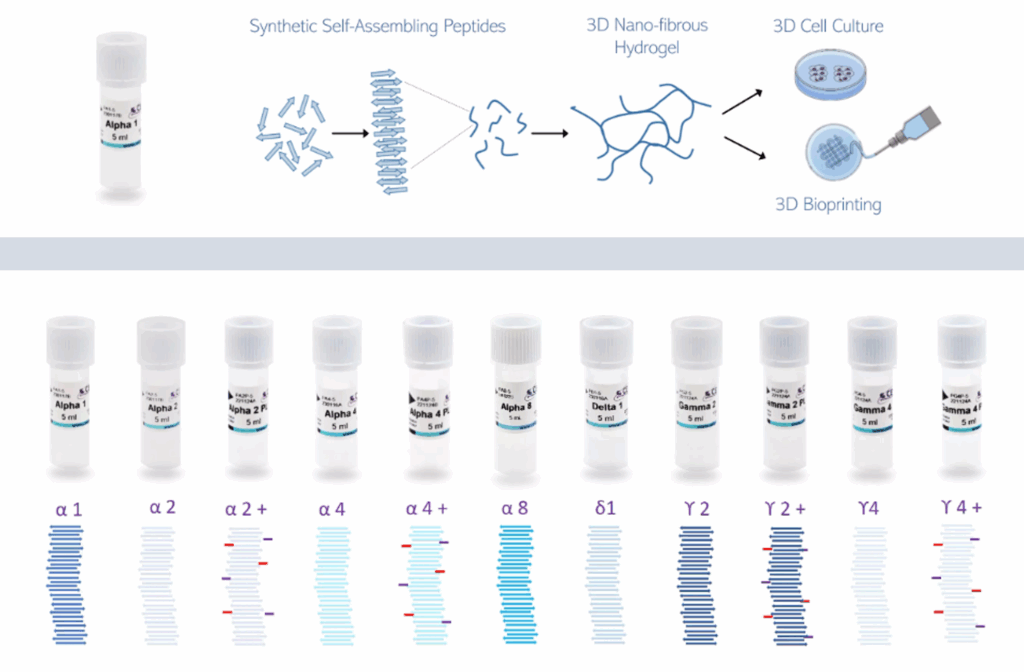
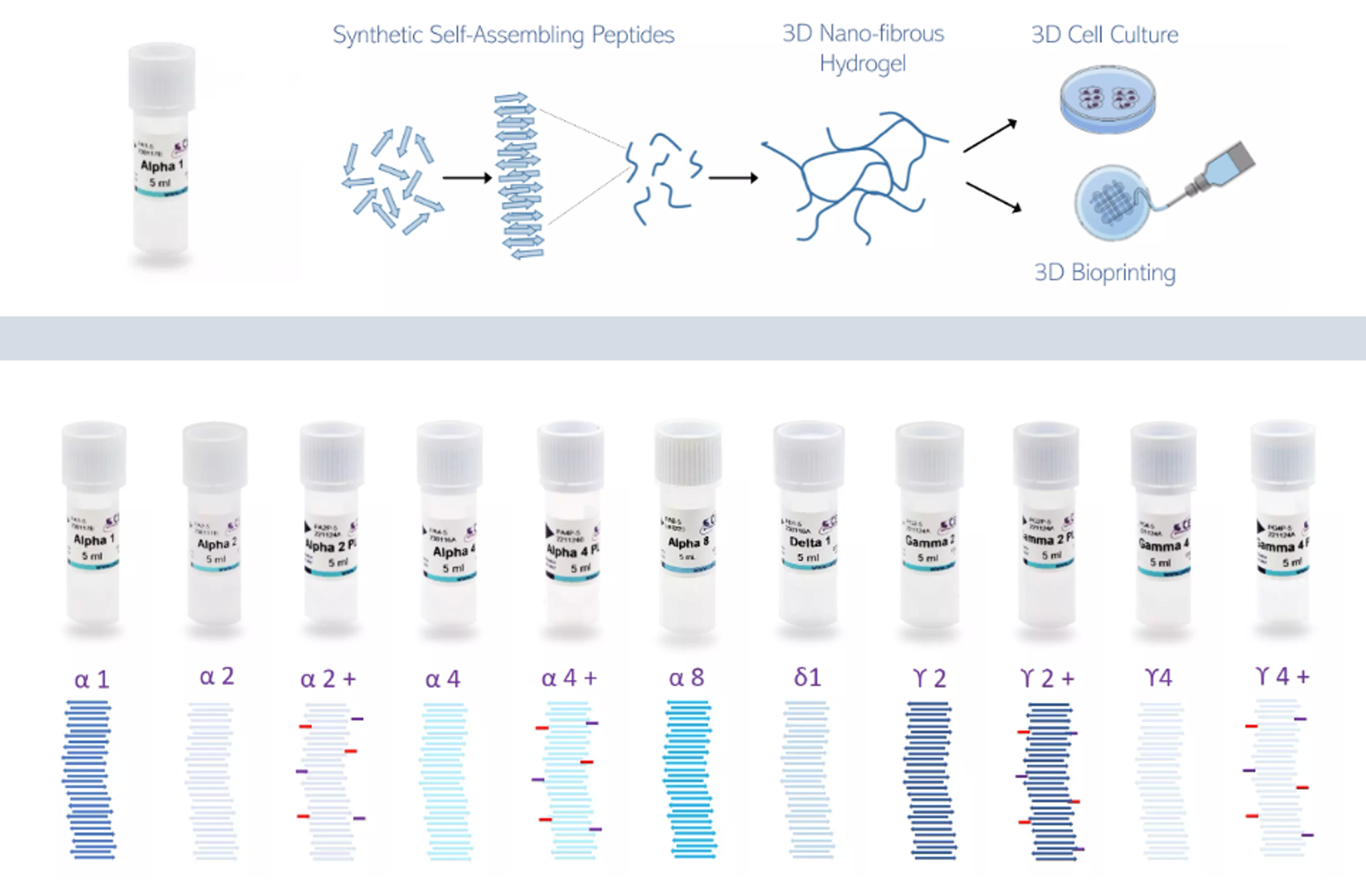
Cell Guidance Systems‘ PeptiGel® self-assembling peptide hydrogel (SAPH) technology, offers researchers a family of fully synthetic, tunable alternatives to animal-derived matrices.
These short synthetic peptides spontaneously self-assemble into nanofibrous 3D hydrogel networks that closely mimic the native extracellular matrix (ECM).
Self-Assembly: Short synthetic peptides stack together to form organized 3D nanofibrous matrix hydrogel networks, creating an environment that mimics natural tissue architecture.
Tunable Properties: The peptide backbone sequence can be modified to affect key characteristics such as charge distribution and mechanical elasticity, allowing customization for specific applications.
Bioactive Integration: Functional peptide motifs from key ECM proteins, including RGD (fibronectin), GFOGER (collagen), IKVAV (laminin), and YIGSR (laminin), can be completely integrated into the hydrogel structure, providing biochemical cues that enhance cell behaviour.
Physiological Relevance: PeptiGels provide a synthetic extracellular matrix that maintains physiological conditions while offering unprecedented control over the cellular microenvironment.
| Feature | Animal-Derived Matrices | PeptiGel® |
| Consistency | Batch-to-batch variation | Reproducible, quality-controlled manufacturing |
| Mechanical Properties | Fixed stiffness | Tuneable to match all human tissue types |
| Biochemical Function | Limited control | Customizable with specific bioactive sequences |
| Ethical Considerations | Animal-derived | 100% synthetic and animal-free |
| Translatability | Variable composition | Fully defined, clinically translatable |
| Handling | Temperature/pH sensitive | Ready-to-use at room temperature |
| Versatility | Limited applications | Sprayable, injectable, and printable |
| Transparency | Often opaque | Optically clear for live imaging |
Mechanically Tuneable: The PeptiGel family offers a range of mechanical strengths and viscosities, enabling optimization for different cell types and bioprinting applications. The available stiffness range covers all human tissue types, providing precise control over cell behaviour and fate determination.
Biochemically Functional: Bioactive peptide sequences are seamlessly incorporated into the hydrogel structure, influencing the dynamic interplay between cells and their ECM environment. This integration ensures consistent presentation of biological signals.
Animal and Pathogen Free: As fully synthetic constructs, PeptiGels eliminate ethical concerns regarding animal use while providing enhanced safety and reproducibility. They're formulated to closely mimic human tissues, increasing translational relevance.
Resorbable and Permissive: Being peptide-based, PeptiGels are naturally degraded by cellular proteases such as matrix metalloproteinases, allowing complete absorption within weeks while enabling natural cell migration patterns.
Versatile Delivery: The shear-thinning properties enable flexible handling through high-throughput liquid systems, extrusion-based bioprinting, and targeted delivery via injection, spray, or endoscopic procedures.
PeptiGel technology has demonstrated success across diverse research applications:
Tissue Engineering: From pancreatic ductal adenocarcinoma models to oesophageal stromal fibroblast cultures, PeptiGels support a wide range of cell types while maintaining their native characteristics.
3D Disease Modeling: The ability to create physiologically relevant 3D environments enables more accurate disease models with enhanced predictive value compared to traditional 2D cultures.
Drug Discovery: Transparent gels compatible with live-cell imaging allow real-time monitoring of drug effects and cellular responses, accelerating screening processes.
Regenerative Medicine: The biocompatible, resorbable nature makes PeptiGels ideal for cell therapy applications where the scaffold needs to integrate with host tissue.
Bioprinting Applications: Tuneable rheological properties enable precise extrusion-based bioprinting of complex tissue constructs with embedded cellular components.
One of PeptiGel's most powerful features is the ability to create custom formulations tailored to specific research needs. The chemistry, mechanical properties, and bio-functional characteristics can all be modified to create bespoke products that optimize cellular outcomes for particular applications.
This customization extends to:
PeptiGel technology provides more controlled, reproducible, and ethically sound cell culture practices. By providing researchers with fully synthetic, tunable hydrogels that closely mimic natural ECM environments, PeptiGels bridge the gap between simplified 2D cultures and complex in vivo conditions.
As the field moves toward more sophisticated tissue models and regenerative therapies, PeptiGel's combination of tunability, reproducibility, and clinical translatability positions it as a key enabling technology. From high-throughput drug screening to personalized cell therapies, PeptiGels provide the foundation for next-generation biotechnology applications that demand both precision and reliability.
The transition from animal-derived matrices to synthetic alternatives like PeptiGel represents not just a technological advancement, but a fundamental improvement in how we approach cell biology research, offering greater control, enhanced reproducibility, and improved translational potential for advancing human health.
For more information on the PeptiGel products, please contact your account manager.


Delivery of Bioactive Molecules | PODS | Growth factors | Small molecules | Cells | Exosomes | PeptiGels & ECMs | Custom PODS | Exosome NTA Service
We gladly support you by keeping you updated on our latest products and developments