Luminescent proximity assays from Antibodies.com are sensitive, versatile and homogeneous bead-based assays for high-throughput quantitation of single analytes or interactions between binding partners.
At the heart of luminescent proximity assays lies the transfer of energy between two types of beads: donor beads and acceptor beads (Figure 1). These beads can be bound to any target molecule of interest via specific antibodies or other binding agents. When the target molecules interact, the beads are brought into close proximity, allowing energy transfer from donor to acceptor beads following appropriate excitation. This results in an emission of chemiluminescence that is proportional to the strength of the interaction. The assay can be adapted to measure the concentration of single analytes (similar to an ELISA) with antibodies that target distinct epitopes on the same antigen.
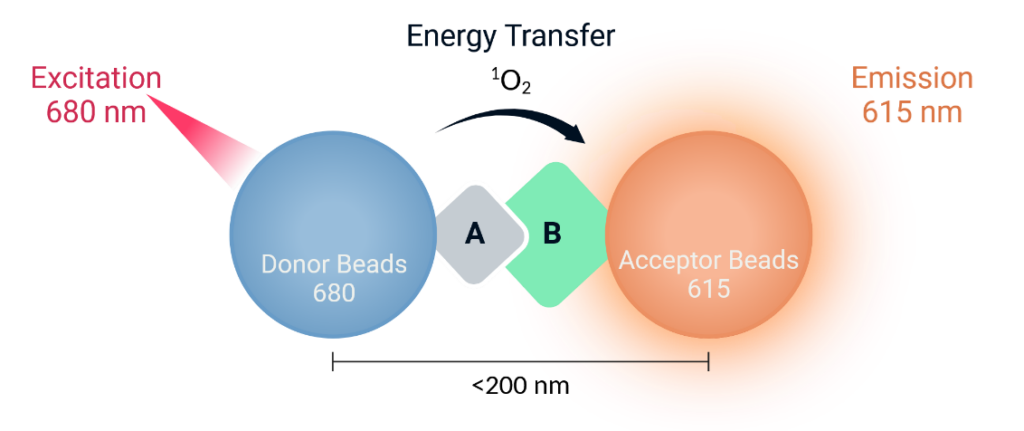
The energy transfer between the beads occurs via singlet oxygen (1O2), and is based on luminescent oxygen-channelling immunoassay (LOCI) chemistry. Singlet oxygen can travel up to 200 nm from its source, a distance that is significantly larger than similar technologies such as FRET (~9 nm). This means that luminescent proximity assays can more easily detect molecular interactions while still minimizing background signal and delivering exceptional sensitivity.
A large variety of high and low affinity biomolecular interactions can be rapidly measured with luminescent proximity assays due to the relatively large distance allowed between the beads (200 nm) and the ease of binding beads to target molecules. As homogeneous assays, luminescent proximity assays eliminate cumbersome wash steps, making them ideally suited for automation, miniaturisation, and large‐scale screening.
Applicable to both cell-based and cell-free systems, luminescent proximity assays are commonly used in high-throughput screens to find pharmacological agents or inhibitors that modulate interactions. These include protein-protein interactions such as ligand-receptor and kinase-substrate interactions, as well as binding between other biomolecules, such as protein-DNA, protein-peptide, and lipid-lipid interactions.
As well as studying known interactions, luminescent proximity assays can be used to identify novel binding partners, characterise PROTAC molecules, perform anti-drug antibody assays, detect SNPs, and replace ELISAs for highly sensitive single analyte detection.
Contact your account manager for further insights on the advantages and applications of luminescent proximity assays.
| A334410 | Anti-His Tag Acceptor Beads 615 |
| A334411 | Anti-Digoxygenin Acceptor Beads 615 |
| A334412 | Anti-FITC Acceptor Beads 615 |
| A334413 | Anti-FLAG Acceptor Beads 615 |
| A334414 | Anti-GST Acceptor Beads 615 |
| A334415 | Anti-Human IgG Fc Acceptor Beads 615 |
| A334416 | Anti-Mouse IgG Fc Acceptor Beads 615 |
| A334417 | Anti-Rabbit IgG Fc Acceptor Beads 615 |
| A334418 | Biotin Acceptor Beads 615 |
| A334419 | GSH (Glutathione) Acceptor Beads 615 |
| A334420 | Protein A Acceptor Beads 615 |
| A334421 | Protein G Acceptor Beads 615 |
| A334422 | Streptavidin Acceptor Beads 615 |
| A334423 | Unconjugated Acceptor Beads 615 |
| A334424 | Anti-His Tag Donor Beads 680 |
| A334425 | Anti-Digoxygenin Donor Beads 680 |
| A334426 | Anti-FITC Donor Beads 680 |
| A334427 | Anti-FLAG Donor Beads 680 |
| A334428 | Anti-GST Donor Beads 680 |
| A334432 | Biotin Donor Beads 680 |
| A334433 | GSH (Glutathione) Donor Beads 680 |
| A334434 | Protein A Donor Beads 680 |
| A334435 | Protein G Donor Beads 680 |
| A334436 | Streptavidin Donor Beads 680 |
| A334437 | Unconjugated Donor Beads 680 |
| A334438 | Anti-c-Myc Acceptor Beads 615 |
| A334440 | Anti-Human IgG Fc Donor Beads 680 |
| A334441 | Anti-Mouse IgG Fc Donor Beads 680 |
| A334442 | Anti-Rabbit IgG Fc Donor Beads 680 |
| A334443 | Biotin Acceptor Beads 545 |
| A334444 | Streptavidin Acceptor Beads 545 |
| A334445 | Anti-Rabbit IgG Fc Fluorescent Beads 680/615 |
| A334446 | Streptavidin Fluorescent Beads 680/615 |
| A334447 | Unconjugated Acceptor Beads 545 |
| A334448 | PhosphoCAPTR Tagged Beads 615 |
| A334449 | Nickel Chelate Tagged Beads 615 |
| A334450 | Nickel Chelate Tagged Beads 680 |
| A334451 | Anti-Human IgG Fc Fluorescent Beads 680/615 |
| A334452 | Anti-Mouse IgG Fc Fluorescent Beads 680/615 |
| A334453 | Unconjugated Fluorescent Beads 680/615 |



Antibodies | Proteins & Peptides | ELISA Kits | Custom Antibody Services | Cost-Effective | WB, ICC/IF, IHC, IP, Co-IP, Flow Cytometry FC, ChIP, ELISA | Technique Guides
We gladly support you by keeping you updated on our latest products and developments