
Recent studies reveal full-length laminin-521 matrix, Biolaminin®, significantly enhances single-cell survival of stem cells, boosting cloning efficiency for both basic research and clinical applications.
Over a decade ago, the development of recombinant laminin-521 coating matrix replaced feeder cells for pluripotent stem cell (PSC) culture, enabling single-cell passaging. The intrinsic signaling from laminin, naturally present in the stem cell microenvironment, even obviated the need for apoptosis inhibitors. Now, it is demonstrated that laminin-521 markedly enhances survival of a single stem cell post gene editing and sorting.
In a study published in Stem Cell Reports by Namipashaki et al. 2023, switching the matrix to Biolaminin 521 increased single-cell survival from 36 % to 70 %, accompanied by an outstanding transfection efficiency exceeding 97 %. This optimization of the cell culture matrix had the most significant impact on the cloning efficiency of CRISPR-edited iPSCs.
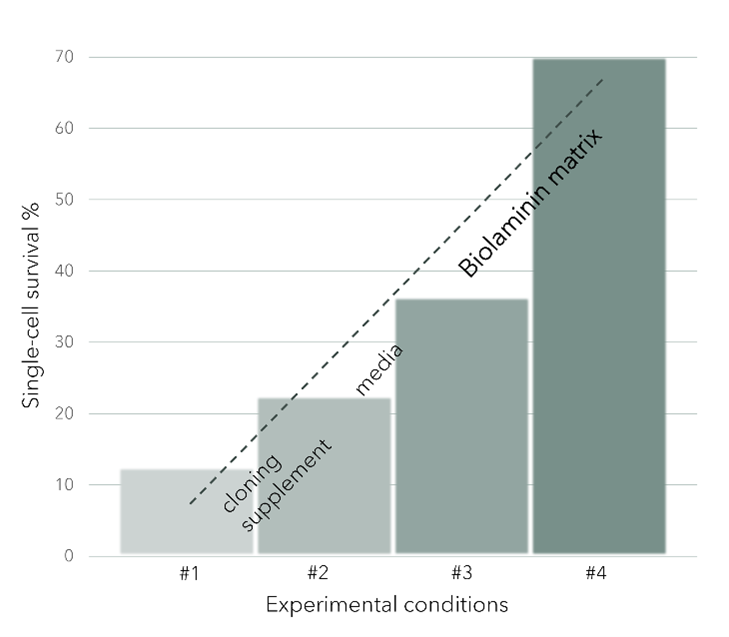
The efficacy of Biolaminin 521 was further acknowledged in the defined hPSC single-cell cloning protocol by Tristan and colleagues (Nature Protocols, 2023). The protocol details cloning with a small-molecule cocktail, utilizing microfluidics-based cell sorting and repeated automated live-cell imaging. Biolaminin 521 is strongly recommended over Vitronectin to improve single-cell survival and efficiency. Their strategy promotes the viability and cell fitness of self-renewing stem cells, producing stable clonal cell lines in a scalable way.
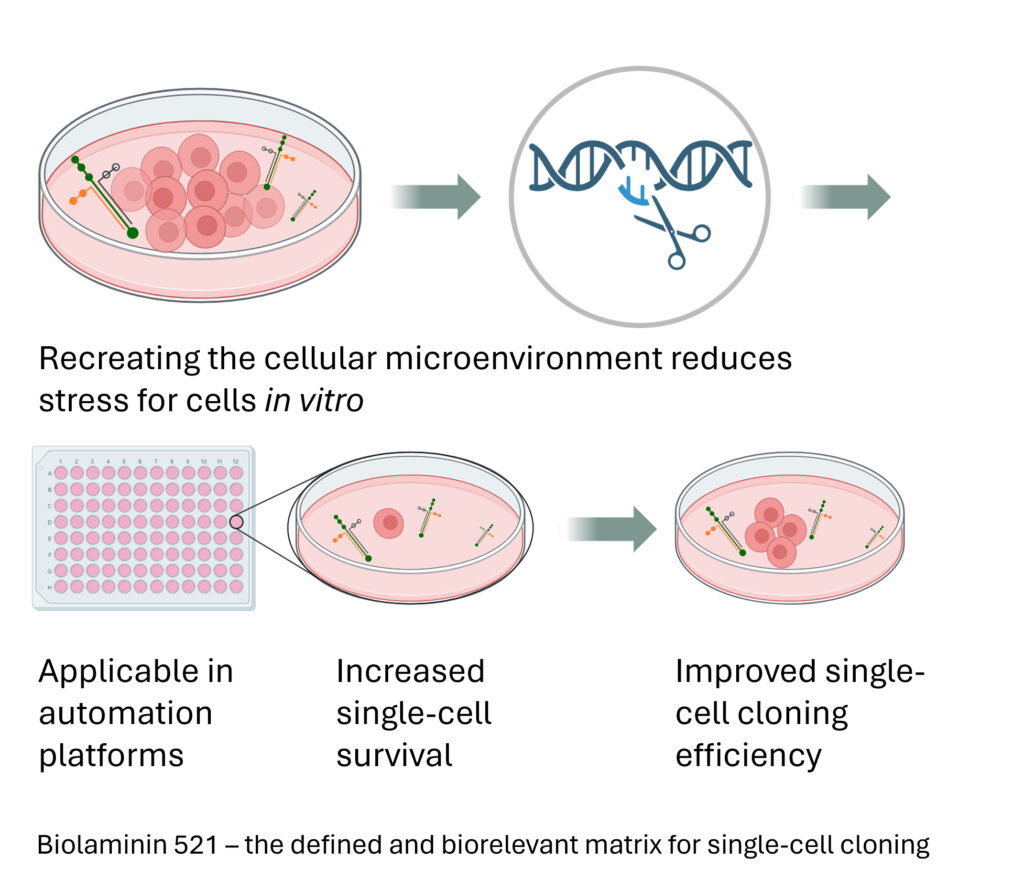
Single-cell cloning is a method used to isolate and propagate a single cell into a colony of genetically identical cells, often including genome editing. This process is commonly utilized in stem cell research and in therapeutic applications such as in precision medicine.
In addition to providing fast cell recovery, Biolaminin 521 is a pure matrix suitable for automated imaging for clone quality control. Using the same matrix from PSC maintenance to new clone expansion and differentiation results in a maximally stable cell behavior.
Tristan, C.A., Hong, H., Jethmalani, Y. et al. Efficient and safe single-cell cloning of human pluripotent stem cells using the CEPT cocktail. Nat Protoc 18, 58–80 (2023). https://doi.org/10.1038/s41596-022-00753-z
Namipashaki A, Pugsley K, Liu X. et al. Integration of xeno-free single-cell cloning in CRISPR-mediated DNA editing of human iPSCs improves homogeneity and methodological efficiency of cellular disease modeling. Stem Cell Reports 18, 2515–2527 (2023). https://doi.org/10.1016/j.stemcr.2023.10.013
Vallone, V. F., Telugu, N. S., Fischer, I., Miller, D., Schommer, S.,Diecke, S., & Stachelscheid, H. (2020). Methods for automatedsingle cell isolation and sub-cloning of human pluripotent stemcells.Current Protocols in Stem Cell Biology,55,e123. https://doi.org/10.1002/cpsc.123
Rodin, S., Antonsson, L., Hovatta, O. et al. Monolayer culturing and cloning of human pluripotent stem cells on laminin-521–based matrices under xeno-free and chemically defined conditions. Nat Protoc 9, 2354–2368 (2014). https://doi.org/10.1038/nprot.2014.159
Figure 2 is created with BioRender.



Cell Culture Matrices | ECM | Biolaminin | Biosilk | Cell Therapy Grade Biolaminin 521 | 3D cell culture
We gladly support you by keeping you updated on our latest products and developments