
Research shows the tumor microenvironment’s key role in therapy resistance. RayBiotech’s platforms profile 8000+ proteins, aiding in mapping tumor-immune interactions, identifying biomarkers, and uncovering drug resistance.
Decades of intensive research into the tumor microenvironment (TME) have revealed its crucial role in modulating therapeutic efficacy and resistance through dynamic cellular crosstalk. Tumor stromal cells secrete diverse signaling molecules that drive oncogenic pathways, immune evasion, and epigenetic reprogramming. These complex signaling networks present both challenges and opportunities for therapeutic intervention.
Recent advances in affinity proteomic technology have enabled systematic interrogation of TME-derived factors through high-throughput protein profiling. RayBiotech’s Antibody Array platforms have pushed the limits of multi-analyte profiling, expanding array panels which previously captured several hundred proteins to 8000+ proteins, while maintaining their ng to pg/ml sensitivity. These high-density array platforms have emerged as powerful tools for mapping tumor-immune interactions, identifying predictive biomarkers and uncovering drug resistance mechanisms.
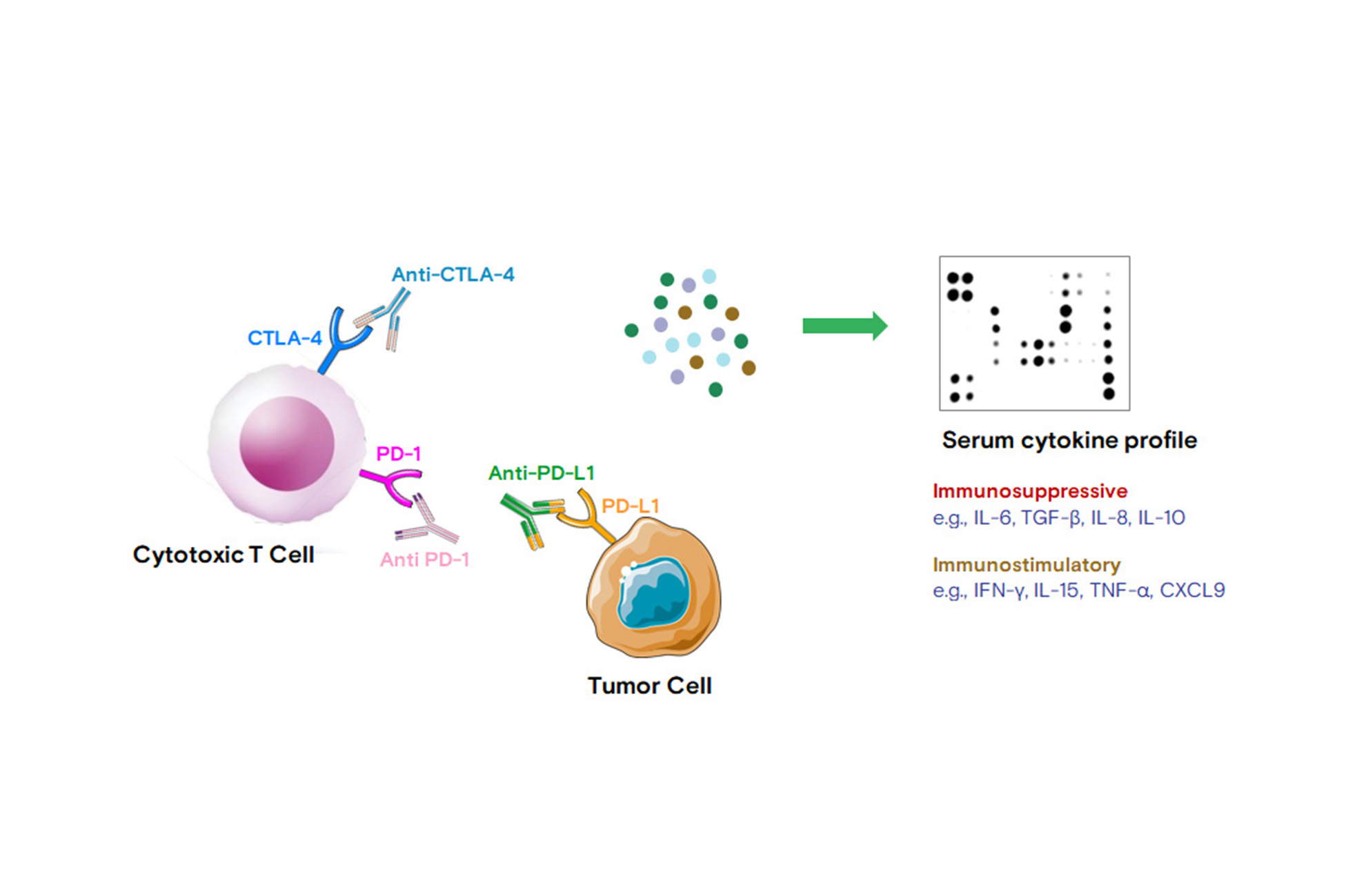
Immune checkpoint inhibitors (ICIs) have transformed cancer treatment for patients with locally advanced or metastatic solid tumors, offering significant survival benefits across several cancer types. Nevertheless, the efficacy of ICI therapy is sometimes limited by primary or adaptive resistance. There is thus an urgent need for predictive biomarkers to better identify responders and optimize patient selection.
RayBiotech’s antibody arrays have proven useful in many studies where cytokine profiling of blood revealed critical insights into the tumor microenvironment after ICI, highlighting the utility of this approach in noninvasive monitoring and therapy personalization. We outline 2 case studies demonstrating how RayBiotech’s array technology identified predictive biomarkers and mechanisms of resistance or response.
Harel et al. used the Quantibody® Kiloplex Array to profile 1000 plasma proteins in NSCLC patients receiving ICIs. Non-responders exhibited elevated CXCL8 and CXCL10, chemokines linked to neutrophil recruitment and immunosuppressive pathways (MAPK, NF-kappa B). These patients also showed upregulated neutrophil-related proteins (GRO, PLAUR, PILRA) and metabolic pathways favoring immune evasion. Antibody arrays revealed that combination therapy (ICIs + chemotherapy) improved response rates, suggesting targeting these pathways could overcome resistance.
Laza-Briviesca et al. identified baseline cytokine profiles predictive of complete pathological response in NSCLC patients undergoing neoadjuvant chemoimmunotherapy. The RayBio® Cytokine Array G4000 showed that responders had lower levels of immunosuppressive factors (NT-3, beta-NGF, VEGF-D) pre-treatment. Post-treatment, they showed increased immune-activating markers (4-1BB, MCSF) and reduced immunosuppressive cytokines (Flt-3L, MPIF-1).
These studies demonstrate antibody arrays’ capacity to advance precision oncology through biomarker-based personalization. By enabling simultaneous detection of multiple cytokines in peripheral blood, arrays can open the door to non-invasive, accessible, and real-time monitoring of patient systemic immune responses, and ultimately inform targeted interventions like cytokine inhibition or combination regimens.


Arrays | ELISA | Flow Cytometry FC | Proteins & Peptides | Antibodies | Phosphorylation | Molecular Biology | PCR | Services | GMP, GLP and ISO 13485
We gladly support you by keeping you updated on our latest products and developments