NGS Analysis of Hematology-Oncology Clonality Testing
This news was updated in April 2024
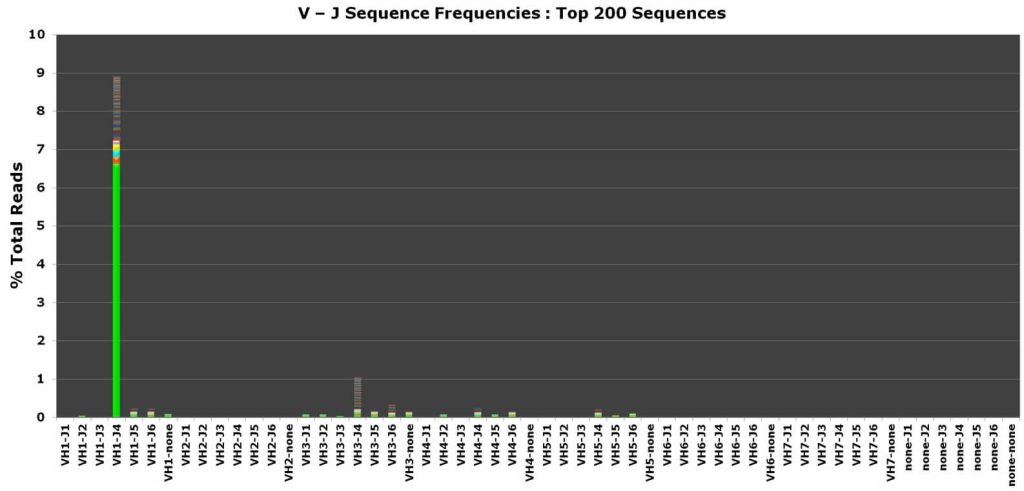
Invivoscribe’s NGS LymphoTrack® Dx Assays are used to detect clonal gene rearrangements, somatic hypermutations and for the study of measurable residual disease (MRD). The full clonality suite of LymphoTrack® Dx Assays are CE-marked and developed for use with the leading NGS platforms, including optimized multiplex PCR master mixes with primers incorporating platform-specific adapters and specimen tracking sequencing identification tags for a one-step PCR workflow. A comprehensive bioinformatics software package is provided free of charge with purchase; enabling you to identify the DNA sequence, clonal prevalence, V-J family identity for each gene rearrangement, and with the IGHV Leader or IGH FR1 assay, the extent of IGHV somatic hypermutation (SHM).
Key benefits of LymphoTrack® Dx Assays
Common sources of DNA – Formalin-fixed paraffin-embedded (FFPE), fresh/frozen tissue, peripheral blood, bone marrow
One-Step PCR Master Mixes
Multiplexing – Reduces Costs by Combining:
Multiple Samples - up to 12 (Ion S5/PGM™) & 24 (MiSeq®)
Multiple Invivoscribe Assays - up to 72 or 168 Samples
Other Platform-Specific Assays
Unparalleled Sensitivity
Unparalleled clonality detection with the ability to identify and track the specific sequence of clonal populations for MRD research studies.
Analysis Software Package - Included
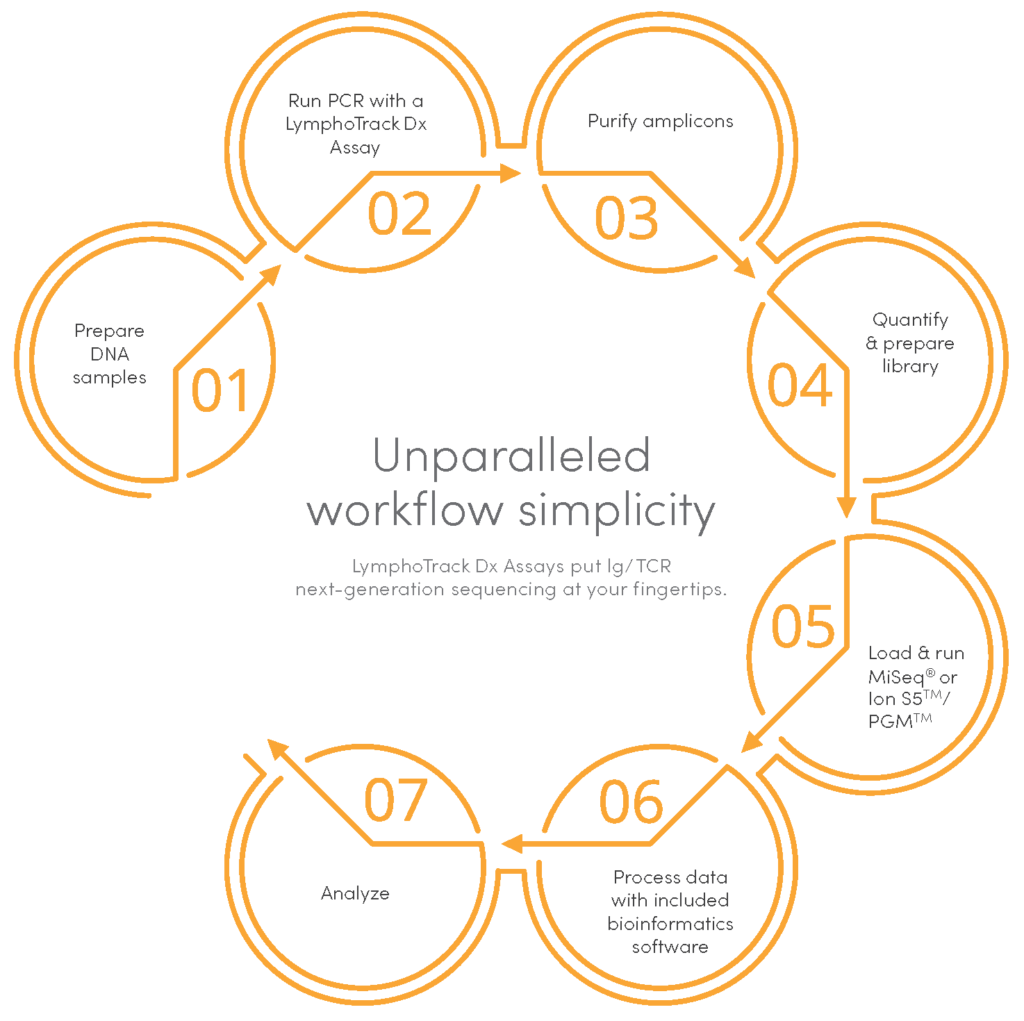
Simple workflow
Multiplexing capabilities
Kits include up to 24 indices to increase workflow flexibility
Designed with the ability to pool multiple targets in a single sequencing run
Decreased testing costs
Increased throughput capabilities
LymphoTrack Dx software
Included with each LymphoTrack® Dx kit
Available for both Ion Torrent S5/PGM™ and Illumina® MiSeq® platforms
Does not require bioinformatics personnel
Can run on most standard Windows platforms
Utilizes FASTQ files
Fast results reported in individual PDF reports or in Excel
Data interpretation
Easy clinical interpretation for the evidence of clonality
DNA sequence, frequency, length, and family directly revealed
Somatic Hypermutation status calculated from IGHV sequencing data
Backed by clinical studies
Clonal sequences can be tracked in subsequent samples
Stamatopoulos B, Timbs A, Bruce D, et al. Targeted deep sequencing reveals clinically relevant subclonal IgHV rearrangements in chronic lymphocytic leukemia. Leukemia. 2017;31(4):837-845.
Shin S, Hwang IS, Kim J, Lee KA, Lee ST, Choi JR. Detection of immunoglobulin heavy chain gene clonality by next-generation sequencing for minimal residual disease monitoring in b-lymphoblastic leukemia. Ann Lab Med. 2017;37(4):331-335.
Lamarche C, Orio J, Georges-Tobar V, et al. Clinical-scale rapid autologous bk virus-specific t cell line generation from kidney transplant recipients with active viremia for adoptive immunotherapy. Transplantation. 2017;101(11):2713-2721.
Levy-Mendelovich S, Lev A, Rechavi E, et al. T and B cell clonal expansion in Ras-associated lymphoproliferative disease (Rald) as revealed by next-generation sequencing. Clin Exp Immunol. 2017;189(3):310-317.